
The erotic is a measure between the beginnings of our sense of self and the chaos of our strongest feelings.
—Audre Lorde, Uses of the Erotic: The Erotic as Power
“My paintings are sentient,” states Robin F. Williams. “By that I mean, the figures I paint know they are paintings. To me they feel like clones, or AI with human emotions, or zombies with hearts of gold.” The New York painter, renowned for monumental depictions of ambiguously gendered individuals, employs a wide variety of media and methods—including oil, airbrush, poured paint, marbling, and the staining of raw canvas—to create complex, contemporary images. Bolstering her facility for traditional painting techniques with craft hacks picked up from TikTok and YouTube videos, Williams stirs references to early modernism, advertising, folk art, and cinema into a confrontational take on the sexualized representation of women across context and period. “They know they are being watched,” she observes of her subjects. “They know what they symbolize.”
Williams was first drawn to narrative, figurative painting as a student at the Rhode Island School of Design in the mid noughties—a time when, as she acknowledges, digital imagery was in the ascendent. For her, the manipulation of recognizable images made possible a new degree of ambiguity that is pertinent to critically exploring the human body’s divergent contexts and meanings. The protagonists of Williams’s paintings can be difficult to pinpoint. At times they seem to merge with their environments and, as her personifying remarks suggest, they toy with and subvert our expectations of power, imbuing the female figure with new agency. Her images are in conversation with each other and refuse to act as simple consumables for the viewer; some are open and we coming, while others embody a spirit of defiance, even hostility.
Williams’s exhibitions of the past few years have been organized around distinct bodies of work, yet there were often strong continuities between them. As the artist confirms, “[t]here are conceptual threads that run through all [her] work, and [she is] always looking for more nuanced ways to explore them.” One such link is her subjects’ evident awareness about their own fabricated nature, whereby their identities often seem to exist in fluid spaces between more traditionally discernible categories. As viewers, we’re prompted to ask questions of the artist and of ourselves as easy recognition becomes an ever more challenging undertaking.
In Sons of the Pioneers, her 2014 exhibition at the New York gallery P.P.O.W, Williams examined gender roles by concentrating entirely on men rather than through any kind of side-by-side comparison, twisting our presuppositions of traditional portraiture in the process. Where we might have expected to see reclining women, Williams gave us consciously romanticized scenes of idling and perhaps misdirected men. Using a vignette-like tondo format to emphasize the voyeuristic nature of her and our relationship to each scene, she deliberately set herself apart from these feckless guys, casting them in strange light that fused picturesque—if at times mocking—fantasies with a quasi-anthropological observation. For example, in “Gold Panner” (2013) a man in a fruitless search for gold sits listlessly, stroking the surface of his empty copper dish. Elsewhere, the subject of “Onlooker” (2013) appears even more unfocused as they stare into the middle distance from beneath a blanket, cap, and net.
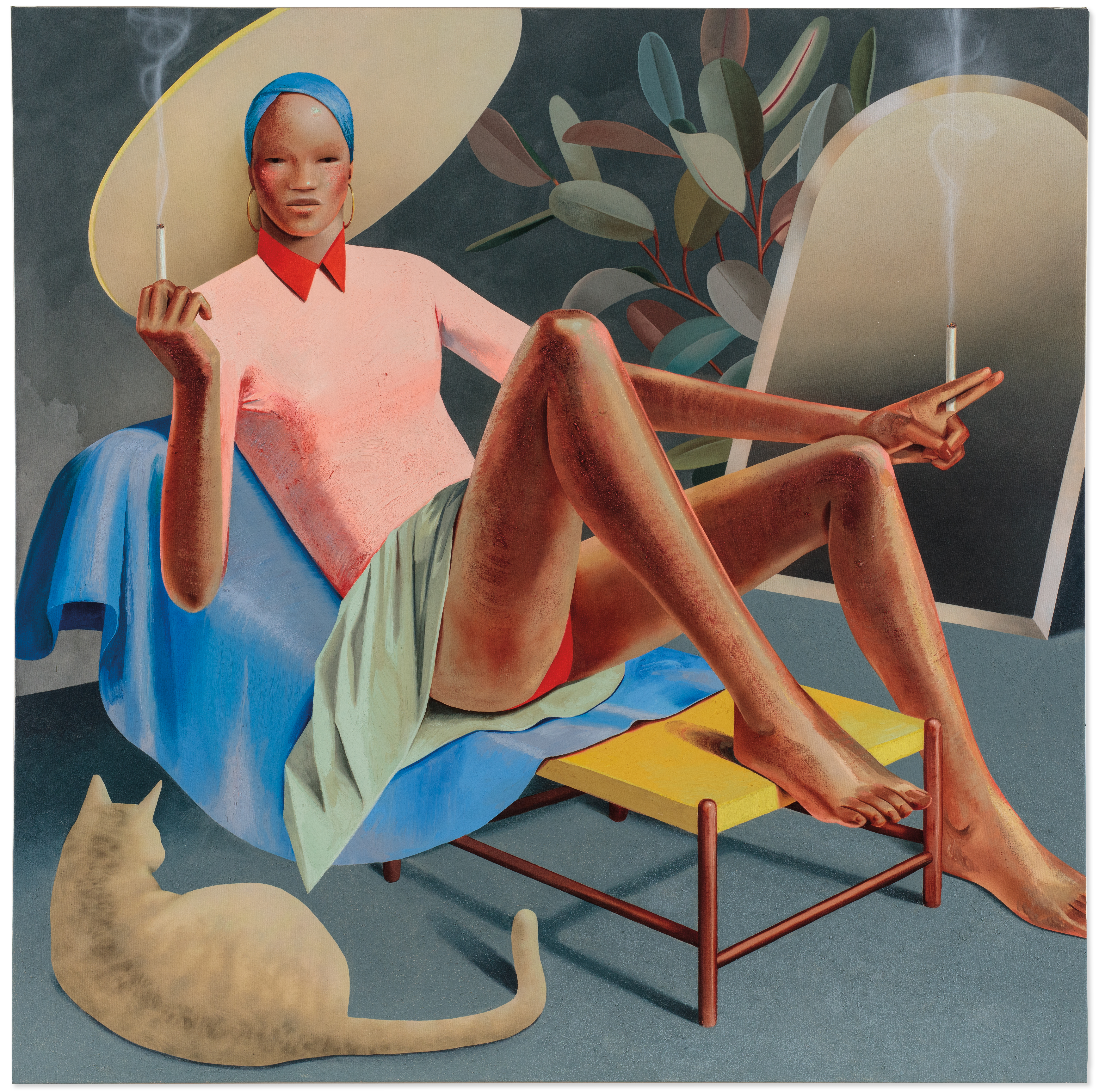
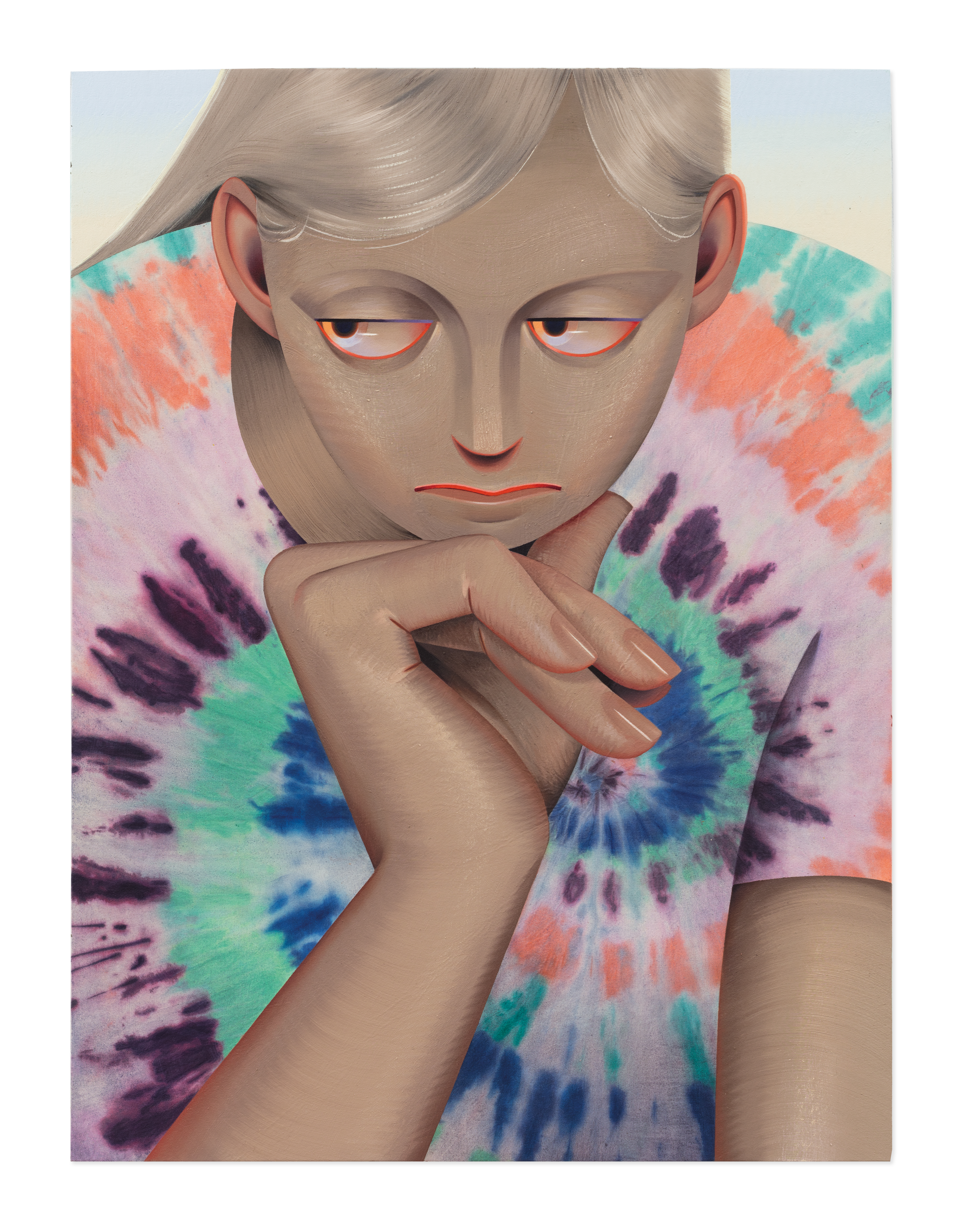
For Your Good Taste Is Showing, her following 2017 exhibition at P.P.O.W, Williams shifted focus back to the female figure in a series of paintings of women adopting uncomfortable poses. The effect was confrontational—a heady tangle of influences, tropes, and suggestions. Drawing on advertisements from the 1970s that were distinguished by their obvious art historical borrowings, she explored the absurd aesthetic standards to which women were, and still are, expected to conform. The show’s titular canvas makes reference to a cigarette ad, blending shades of Vermeer’s “Girl With A Pearl Earring” (1665) with a stylized take on Balthus’s “Girl With A Cat” (1964). Its female subject holds two cigarettes, one of which appears to be giving the middle finger, while her exposed underwear makes explicit the appropriated images’ undercurrent of desire. A characteristically witty redirection of emphasis, Your Good Taste Is Showing examined the interrelated functions of eroticism, agency, and class.
Another key point of reference and source of imagery for Williams is cinema, which has emerged even stronger in her recent work. After spending the past few years compiling examples of exaggerated femininity from a variety of popular genres—chiefly, erotic thrillers, romances, and horror films—Williams is now making use of the heightened narrative and behavioral patterns that were revealed to her. “Often these shots are composed similarly across different films,” she explains. “They’re designed to make the viewer identify with the woman in terror, pleasure, excitement, or despair.” By undertaking roles of hyperfemininity, Williams posits that these individuals generate moments of catharsis that, especially for a heteronormative audience, can deliver “an experience of gender slippage, queer eroticism, or feminist rage” when sublimated into more socially acceptable forms of nudity and violence.
Working off stills she captured with her phone, Williams employs multiple forms of distortion to recall the various technologies and media—from film and television, to videos and cell phones—through which these images have passed to finally become paint on canvas. Yet even as they are transformed, the emotions they elicit not only survive, but intensify, and thus remain valuable. It’s not long before the subjects seem to evolve from being merely the products of visual distortion to the agents of it. As Williams writes, “I want to give the subjects the power to distort the screen. They make the art with their emotions. They are the artists.” Here again, her subjects exert their own kind of existence—one that’s non-living but somehow still self-aware and possessed of the capacity to influence how we the viewers understand ourselves and our world.
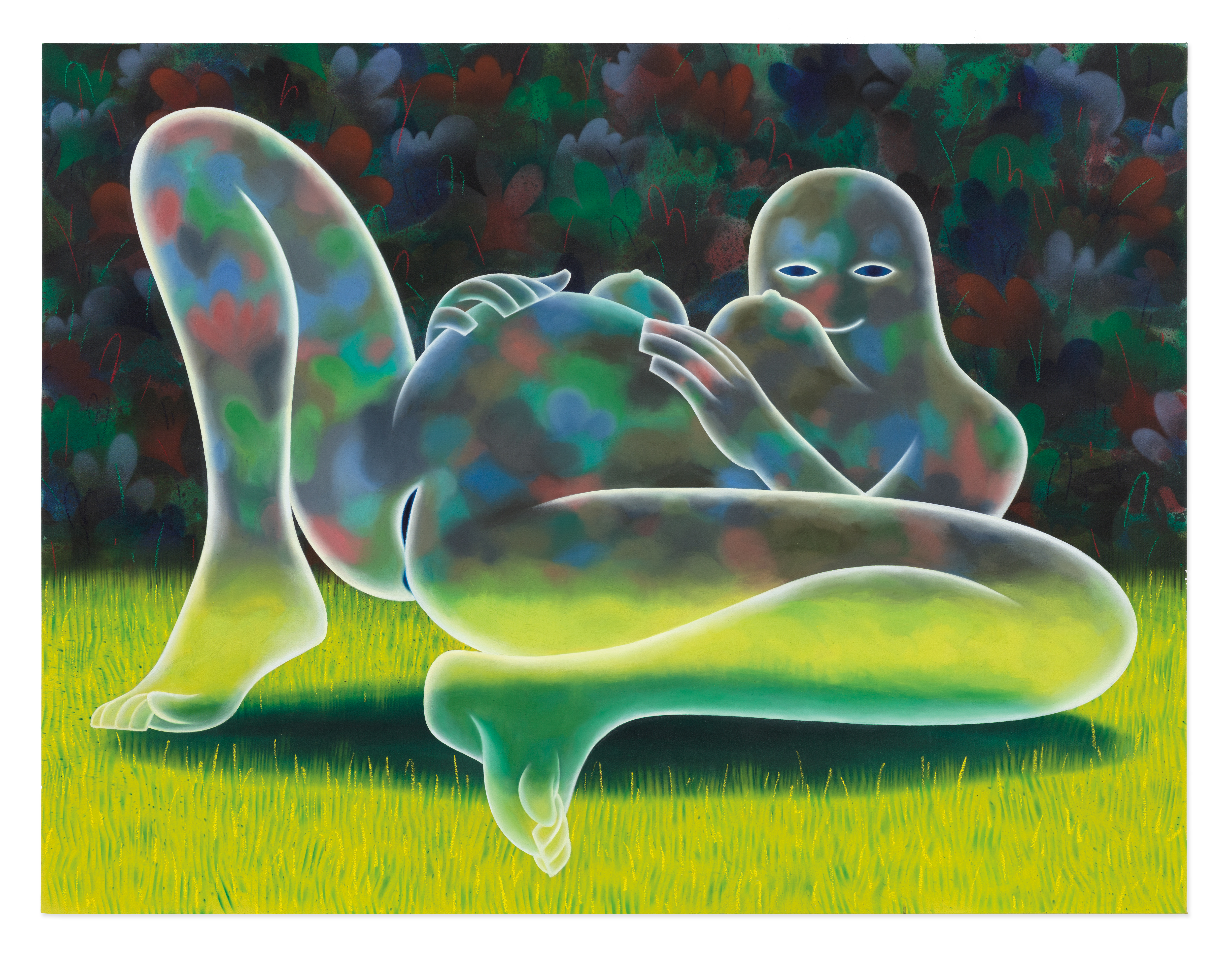
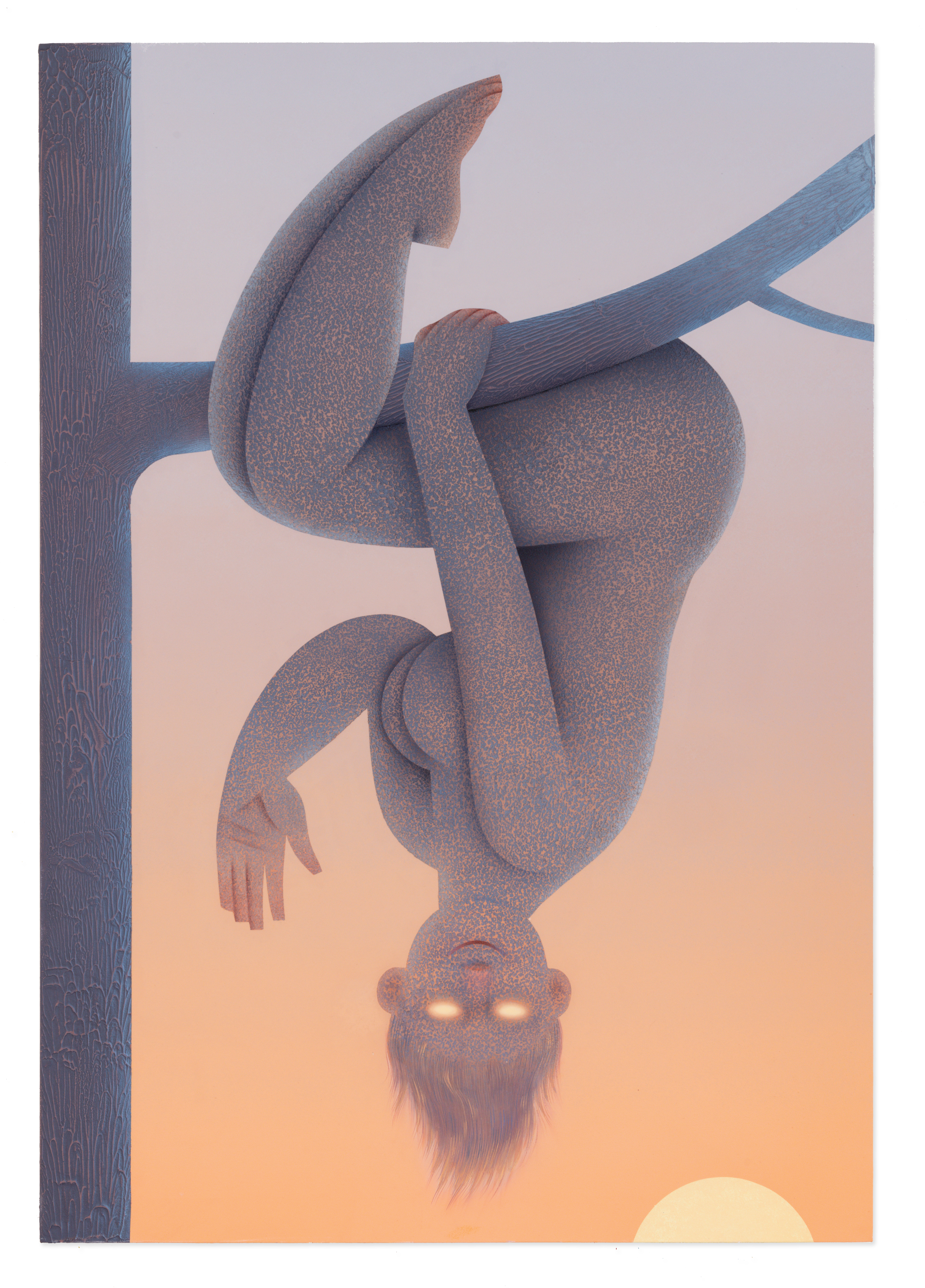
The work in Williams’s fourth exhibition at P.P.O.W, 2021’s Out Lookers, appeared to signal a shift away from her earlier earthly—and earthy—imagery toward something more mysterious and rather paranormal. An established concern with ideas around gender identity remained, the artist describing her subjects as “prisms” that cast light through female identities suffering misrepresentation and attack. The exhibition also found Williams continuing to make explicit references to film. Most notably, Out Lookers pulled from the common theme in sub-mainstream narratives that women and girls are routinely driven to brutal acts of revenge by suffering from a spectrum of fatal flaws that are even more dangerous than those of men. Among the exhibition’s most haunting images was “Final Girl Exodus” (2021) in which a cadre of translucent female figures strides toward a brilliantly glowing horizon. The titular “final girl” is itself a reference to the horror genre trope of a sole female survivor who is often our protagonist and who ultimately must confront the killer. In Williams’s work, however, that narrative is about gender and the role of final girl is altogether more ambiguous.
These works and other projects also cast light on Williams’s range of materials and methods, which reveals how they—as in her references to cinema—extend into realms that can be considered beyond the critical pale. In particular, she makes use of the tools and techniques beloved by hobbyist and decorative painters, not just for their distinctive visual effects, but for their cultural associations as well.
“So much of what we consider ‘low’ in fine art is usually just code for ‘feminine’ or ‘camp’,” Williams reminds us. “Or else we call it ‘folk’ or ‘naïve’, which is code for uneducated.” To create the work, she discovered through a cache of how-to and work-in-progress videos on social media that cheap craft brushes and silicone dish sponges could be as valuable to her as rarified and more costly fine-art gear. Further, Williams found that they might convey something about the lines between innocence and adulthood, labor and value, and class and gender. “It’s no surprise that what reads as expensive and masculine has historically been more valuable to us,” she concludes. “I want to question why that is.” As women, we have come to distrust that power which rises from our deepest and nonrational knowledge. We have been warned against it all our lives by the male world, which values this depth of feeling enough to keep women around in order to exercise it in the service of men, but which fears this same depth too much to examine the possibilities of it within themselves.
—Audre Lorde, Your Silence Will Not Protect You: Essays and Poems
Written by Michael Wilson


