
There are no parents in Kate Hargrave’s paintings of childhood. Her young figures, which appear in poses drawn from both art history and the visual relics of popular culture, inhabit a self-directed realm, unbound by the conventions or temporality of our own society. Over twenty years of working independently in her studio in Maine while raising her own children, Hargrave has used the painting techniques of the old masters to create a world outside of time. Titled after an antiquated term for baby teeth, present for only a few fleeting years between infancy and middle childhood, MILK TEETH is her first exhibition in New York. With these new paintings, Hargrave reimagines the non-time of youth.
Hargrave returns again and again to the same figures and postures, which she has adapted from a personal archive of images that spans from Early Renaissance paintings of Madonna and child to Thomas Gainsborough’s romanticized eighteenth-century peasants to 1970s Holly Hobbie coloring books. The combination of these elements lend her compositions a sense of compressed time, where the sacred iconography of the early modern period rubs up against contemporary visions of childhood. Her technical choices enhance this surreal temporality. She achieves the delicate tonal shifts across her characters’ rounded bodies and throughout their environments through the centuries-old technique of glazing, building up the surface of her compositions with diaphanous washes while still allowing earlier layers to show through. She applies her highlights impressionistically, imagining through chiaroscuro how ambient light might fall, a nonnaturalistic approach that increases the sylphlike figures’ otherworldliness. Hargrave’s gauzy application of paint lends her characters varying levels of substance: in Baby’s Bath (2026), cherubs are so transparent that they at times appear to be part of their stony surrounds, while a central figure’s rosy limbs and cheeks give her an embodied presence. The illumination in The Hand-Me-Down (2026), which enters the painting from an oblique angle and makes its figures glow against the dim interior light, is one of many moments when Hargrave’s command of contrast and shadow suggests a divine presence.
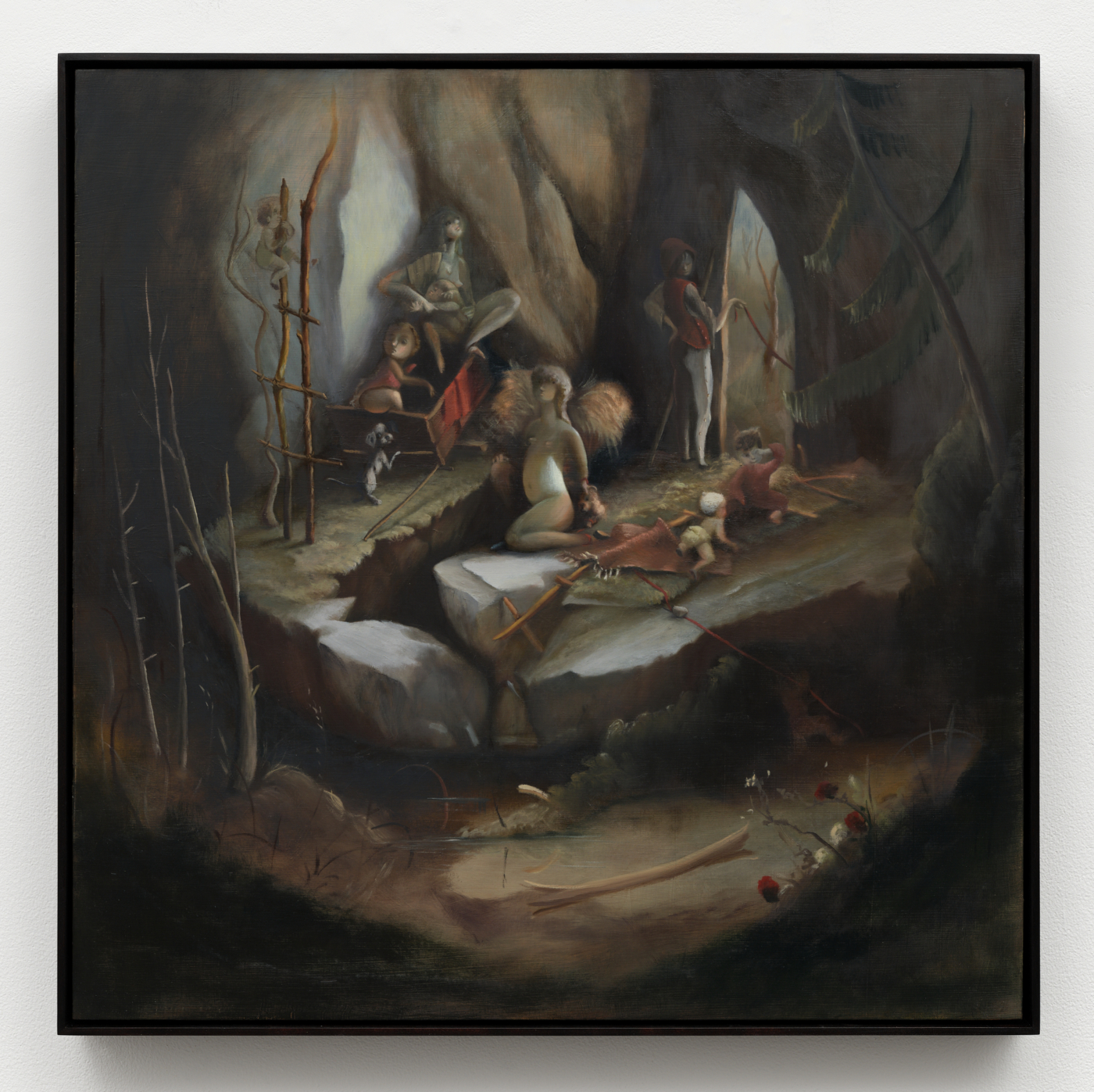
Like da Vinci, Rubens, and others who have informed her painting, Hargrave begins each work with an imprimatura. These foundational, semitransparent stains across raw surfaces establish a luminous midtone that unites the composition. For MILK TEETH, Hargrave used the same limited palette of fundamental colors as seventeenth-century painters like Rembrandt and Velázquez; she has chosen panel as her substrate because it was painting’s primary support until the late-sixteenth century. Sited in a grotto-like space with a deeply receding sfumato landscape framed by stony walls, The Potluck (2026) evokes the unplaceable environment of da Vinci’s enigmatic Virgin of the Rocks (1483–86). Her complex figural groupings and tendency to adopt a distanced vantage point on her subjects, especially in Woodpecker Habitat (2026), recall Hieronymus Bosch’s panoramic visions of paradise. In Hargrave’s work, though, there are no moralistic allegories. Her ever-proliferating figures are free to act, agents rather than objects.
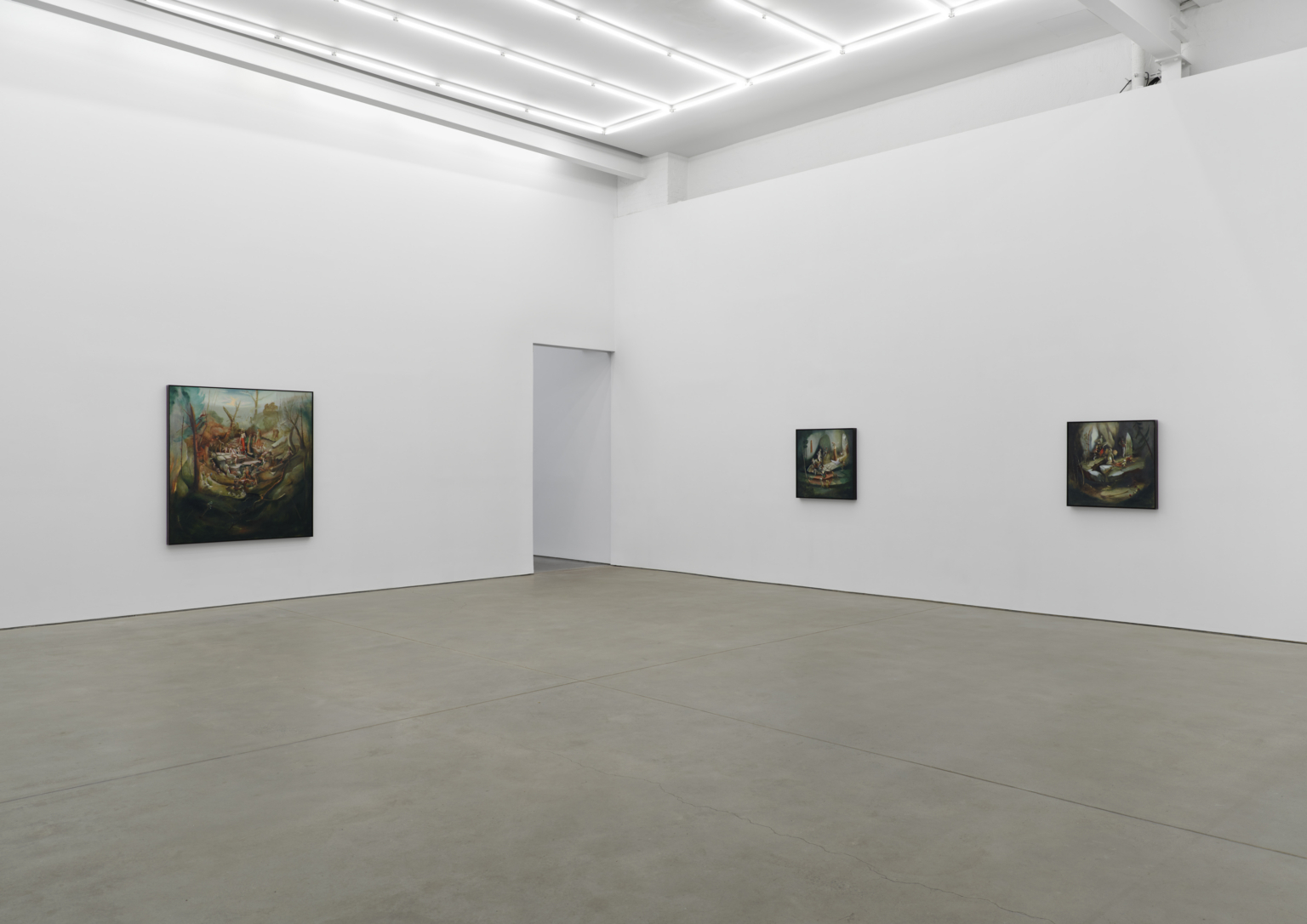
Hargrave’s world is Edenic—the mischief made by its young inhabitants is innocent in nature. At the same time, like Grimm fairytales and Bosch’s imaginings of hell, Hargrave’s fantasies contain elements of darkness, as with a bird attempting to carry a child away in The Potting Shed (2025) or the oversized heads of the babies at the back of The Time Inn (2026). Broken spinning wheels throughout the paintings bring to mind the fable of Rumpelstiltskin, who spun hay into gold in exchange for a woman’s firstborn child. In Hargrave’s world, the wheels are stilled, its denizens protected by their hermetic realm.


